


The Origin Of Species
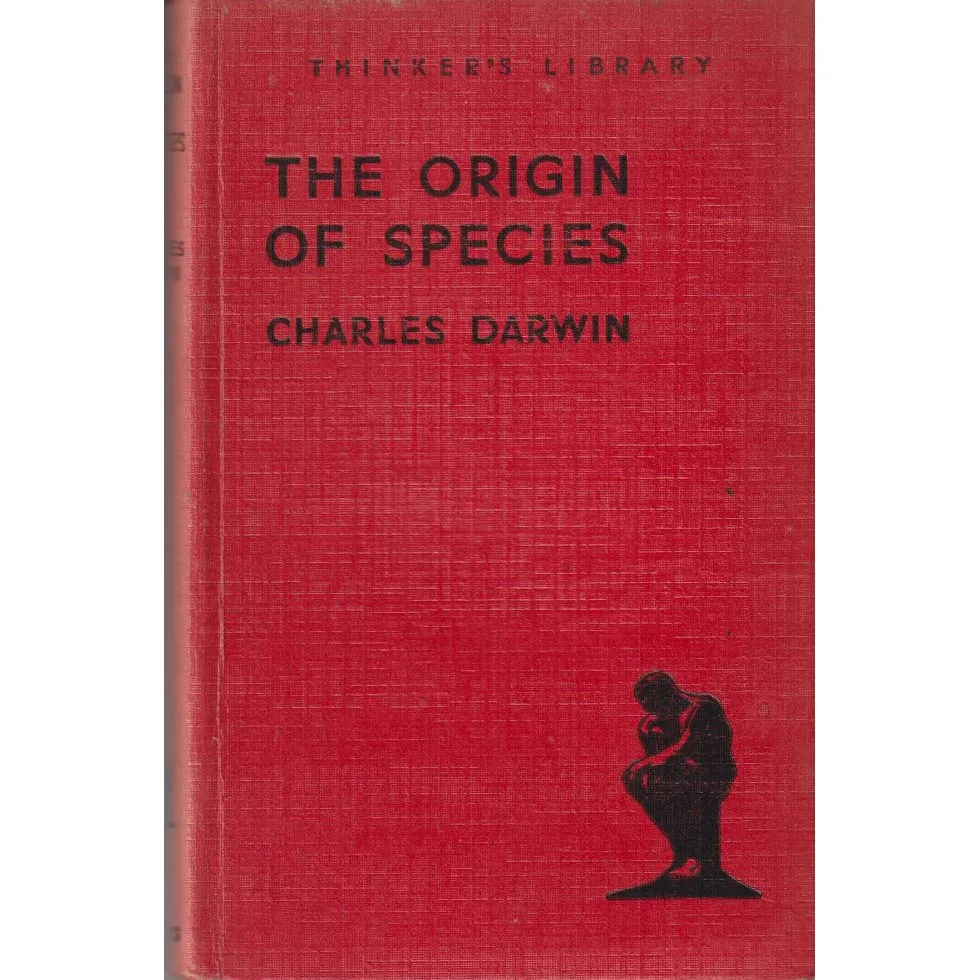
Publisher: Thinkers Library
Format: Hardback
ISBN: none
The Origin of Species (1945) by Charles Darwin — Thinkers Library
ISBN: None (because in 1945, “identification” was a title, an author, and your ability to look mildly serious)
Condition: Good (as sold by Crappy Old Books, where “Good” means “still evolving nicely”)
Here it is: the book that politely strolled into the 19th century, cleared its throat, and rearranged everyone’s understanding of life on Earth. The Origin of Species is Darwin’s greatest hit—except it isn’t a hit in the “catchy chorus” sense so much as the “quietly devastating argument that changes everything” sense. It’s the sort of classic that didn’t just start conversations; it started entire disciplines, ended a few certainties, and gave humanity the uncomfortable gift of perspective.
This is a 1945 Thinkers Library edition, which is its own little piece of cultural theatre. Imagine: the world is crawling out of war, and someone says, “Right. What we need now is a sober, methodical explanation of natural selection.” That is either the most hopeful thing imaginable or the driest form of comfort reading ever invented. Possibly both. Either way, it’s wonderfully fitting: Darwin is the original “keep calm and look at the evidence” author, and 1945 was not short on reasons to want that.
What you get inside is not a pop-science shortcut, not a neat TED Talk, and definitely not a “five-minute summary.” You get Darwin doing what Darwin does: building his case slowly, carefully, and relentlessly, with examples that pile up like pebbles until you realise you’re standing on a mountain. Pigeons. Barnacles. Beetles. Islands. Fossils. The kind of observational obsession that makes you respect the man even as you wonder if he ever had a day off. It’s a book full of phrases that are almost comically modest—“it seems to me,” “I think,” “we may suppose”—while casually explaining one of the most powerful ideas ever put to paper.
And yes, it’s also funny in places, though unintentionally: Darwin’s calm tone when discussing concepts that caused Victorian society to clutch its pearls is a joy. He is the master of the understated bombshell. “Here are some small variations,” he says, and then—boom—everything is connected, nothing is fixed, and life becomes a branching, opportunistic, endlessly inventive mess. Which is, frankly, still the best description of reality we’ve got.
This copy is listed as Good, sold by Crappy Old Books, meaning it’s solid, readable, and has that honest second-hand gravitas. Expect the usual signs of age: maybe some light wear, perhaps a bit of page toning, the faint suggestion that it has been sat on a shelf next to other Serious Ideas and occasionally opened with purpose. It’s not pristine. It’s lived. Which feels appropriate for a book about adaptation.
Buy it if you like:
-
foundational classics that changed the world without shouting
-
arguments built from evidence, patience, and relentless curiosity
-
books that make you look at nature and think, “you clever, chaotic thing”
-
owning a piece of intellectual history that still bites
The Origin of Species (Thinkers Library, 1945): a calm, devastating masterpiece in a sturdy mid-century wrapper—ready to remind you that life is not a ladder, it’s a hedge, and we’re all just doing our best in the branches. Courtesy of Crappy Old Books, naturally.
Keep browsing: See more Nature books Other books by Charles Darwin
